Oct. 07, 2026 | By Douglas Holl, Defense Health Agency Communications


During this time, beneficiaries may be unable to update contact information, verify eligibility, or complete enrollment actions. Access to TRICARE and other DOD benefit systems that rely on DEERS may also be temporarily affected.


Oct. 07, 2026 | By Douglas Holl, Defense Health Agency Communications
As the military community observes Domestic Violence Prevention Month this October 2026, experts at Defense Health Agency-Public Health are urging service members, military leaders, and families to look beyond physical violence and recognize the broader, nonphysical "spectrum of abuse" that can undermine unit and family readiness.
The campaign arrives alongside the release of the Department of War’s Report on Child Abuse and Neglect and Domestic Abuse in the Military for Fiscal Year 2024, which documented 8,076 domestic abuse incidents across the military branches that met official clinical criteria. Of those verified incidents, physical abuse accounted for 68.2% of cases, while emotional or psychological abuse made up 25.6%. These statistics underscore the critical reality that domestic abuse often occurs without a single physical mark.
"When I use the phrase 'spectrum of abuse,' I want service members to understand that abuse can go beyond a black eye or other physical form of abuse," said Army Maj. Michelle Worsley, licensed clinical social worker and deputy director of the Health Promotion and Wellness directorate at DHA-PH in Aberdeen, Maryland. "Domestic violence rarely exists by itself. While physical abuse may be the behavior most people recognize, abusive behaviors can occur before, alongside, or without physical violence."
According to Worsley, domestic abuse involves patterns of behavior used to establish power, control, or intimidation, including limiting financial access, stalking, digital tracking, degradation, and isolating a partner from support networks.
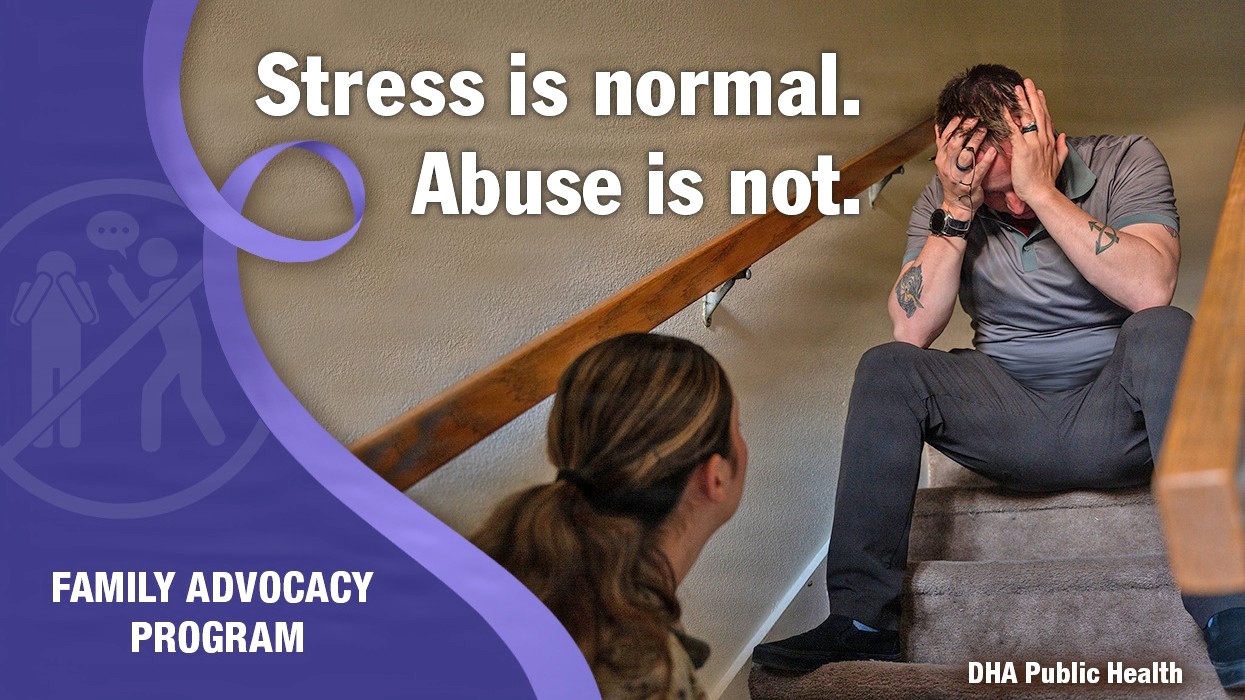
The high-tempo nature of military life, including frequent Permanent Change of Station moves, intense training cycles, and deployments, places unique stressors on relationships. However, clinical experts emphasize that operational stress must never be used to justify controlling behavior. "I emphasize that military life creates stress,” said Worsley. “Stress is normal. Abuse is not. Normal conflict can be uncomfortable at times, but within it, both partners retain their voice. They can disagree, cool down, revisit the issue, compromise, and continue to make independent choices without fearing retaliation."
When relationships cross the line into abuse, a partner's stress increasingly becomes a justification for control. "A PCS doesn’t justify taking away their spouse’s access to money," said Worsley. "A deployment doesn’t justify monitoring every communication their spouse has. And a hard day at work or home doesn’t justify threatening or humiliating their spouse."
For active duty service members or beneficiaries seeking help, the DOW offers two distinct paths through the Family Advocacy Program, both of which grant full access to medical care, victim advocacy, and professional safety planning:
| Feature | Restricted Reporting | Unrestricted Reporting |
|---|---|---|
| Support and Resources | Access to medical care and treatment, confidential counseling, crisis intervention, support services, safety planning and risk assessment. | |
| Confidentiality | Yes. Command and law enforcement are not notified, and reports are kept confidential when given to an authorized FAP provider, Domestic Abuse Victim Advocate (DAVA), or health personnel, outside of situations where there is an imminent threat to safety for the victim. | No. Command and law enforcement are notified, and an official investigation is triggered. This can include enacting a Military Protective Order (MPO) and providing information and assistance or seeking a Civilian Protection Order (CPO) or other legal services. |
| Primary Contact | Speak first with a DAVA or FAP provider to fully understand reporting options. After understanding the reporting options, if unrestricted reporting is chosen, victims can also make the report directly with their command or with military law enforcement. | |
"Choosing a restricted report does not mean choosing to go without care," said Worsley. "With both restricted and unrestricted reports, victims can still receive medical care and treatment, confidential counseling, crisis intervention, support services, safety planning, and risk assessment."
Importantly, Worsley noted that restricted reporting is only available to adult victims. There is no option for restricted reporting in any cases involving child abuse.
Peer-to-peer and leadership support are the first lines of defense in the barracks and motor pools. For single service members concerned about a "battle buddy," Worsley advised starting a private, judgment-free conversation. Asking a simple question like, "I've noticed you haven't seemed like yourself lately. Are you okay?"can establish a lifeline.
For small-unit leaders, the priority must shift from clinical diagnosis to immediate safety, connection, and normalizing help-seeking behavior. "Small-unit leaders can play a more active role in reducing the stigma associated with seeking domestic abuse or relationship counseling by normalizing preventive help seeking," said Worsley. "Don’t just introduce or talk about FAP when an incident occurs. Talk about relationship education and resources available alongside the discussions we routinely have pertaining to maintaining overall unit readiness."
If you or someone you know is experiencing domestic abuse, confidential help is available 24/7. You do not have to navigate this alone: