Nov. 17, 2026 | By Kristiana Gehly, Portfolio Acquisition Executive Marine Corps


Nov. 17, 2026 | By Kristiana Gehly, Portfolio Acquisition Executive Marine Corps
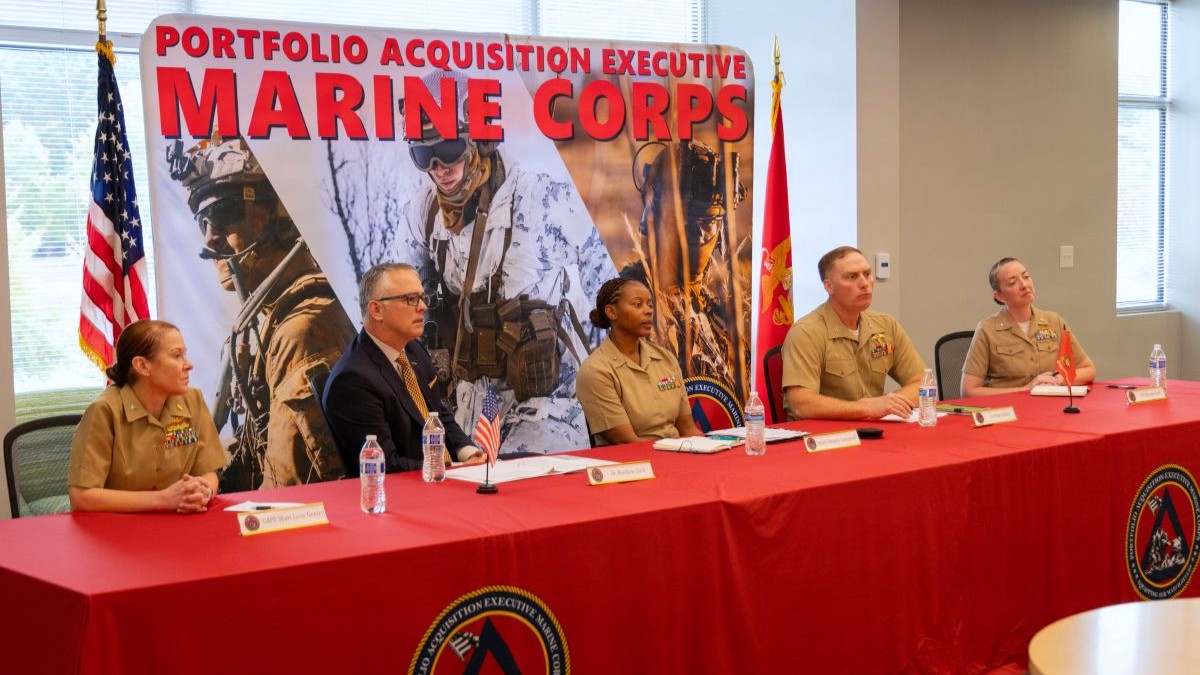
Portfolio Acquisition Executive Marine Corps hosted a media day and roundtable Oct. 16 to discuss medical capabilities, acquisition priorities, and challenges and solutions to providing care to Marines in contested environments.
Reporters from across the country participated in a moderated question-and-answer session with PAE MC leadership, Defense Health Agency officials, and subject matter experts from the Expeditionary Medical Systems team within Program Manager Combat Support Systems.
PAE MC’s mission is to improve accountability and accelerate the fielding of urgently needed capabilities to the warfighter. Modernizing expeditionary medical systems involves more than fielding equipment; it also requires an integrated approach that ensures that forward deployed forces have access to reliable power, fuel, potable water and consumables to sustain medical operations before the shooting begins—while also reducing the logistical footprint. “Our mission is clear,” said Brig. Gen. Tamara Campbell, Deputy Portfolio Acquisition Executive. “We’re here to deliver mission-ready capabilities at the speed of relevance.”
Earlier this year, PM CSS fielded two modernized medical equipment sets for Damage Control Resuscitation and Damage Control Surgery, providing modular medical capabilities tailored to the distributed operations envisioned under Expeditionary Advanced Base Operations.
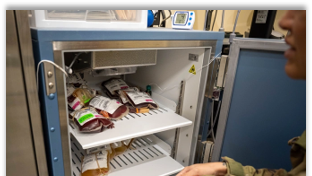
The roundtable highlighted four key devices from the sets: the Marine Corps Squad Power Manager Medical Kit Variant, the Expeditionary Medical Refrigeration Unit, the KOSMOS Point of Care Ultrasound, and the MEQU Blood Warmer.
Sustaining and saving warfighters’ lives remains a top priority in any military operation. As the Joint Force continues to shift its focus from the urban combat and counterinsurgency operations that characterized much of the Global War on Terror to the vast, contested expanses of the Pacific theater, the challenges of providing lifesaving medical care are changing.
The prospect of a more lethal battlefield brings the risk of increasingly severe injuries, including burns and complex trauma requiring surgical intervention. At the same time, greater distances, dispersed operations, and contested evacuation routes could delay access to definitive medical treatment.
Anticipating these challenges, PM CSS’ EMS team has worked to close the gap between initial lifesaving treatment and definitive medical care, developing capabilities designed to sustain casualties for longer periods in austere environments.
These upgraded medical systems do just that. “What we are trying to get after…is saving that life in the first hour and ensuring that [the equipment] can be distributed, applied, carried on the back of a corpsman, and supported logistically,” said Cmdr. Kyleigh Hupfl, a pharmacist with the EMS team.
While immediate treatment remains critical following a traumatic injury, operational realities may prevent the timely evacuation of casualties. Medical teams must therefore be equipped not only to deliver life-saving care, but also to sustain patients for extended periods until evacuation becomes possible.
During the roundtable, Col. Paul Gillikin, Program Manager, Combat Support Systems, emphasized the importance of equipping medical teams for austere environments and operations across the vast distances of the Pacific, where logistics and casualty evacuation will likely be contested.
“Our modernization efforts were informed by a campaign of learning that combined field experimentation with direct feedback from medical professionals across all three Marine Expeditionary Forces and Marine Forces Reserve, whose civilian medical practitioners bring invaluable real-world clinical and surgical expertise to the fleet,” said Gillikin. “We tested equipment against objective operational requirements and modeled injury rates and severity against the realities of contested logistics and conflict with a peer adversary. This represents a fundamental shift from GWOT operations to the requirements of EABO. We’re moving beyond the golden hour toward longer patient-care hold times while reducing our logistical footprint. That’s what makes DCR/DCS optimization so important. Medical operations and logistics must work hand in glove more than ever before.”
As pressure from our adversaries continues to build, acquisition professionals at PAE MC are leaning forward to remain one step ahead. “We’re in a different time and space now,” stressed Campbell. “The enemy absolutely gets a vote. We have our near and peer competitors that are moving along and cycling with technology at the same pace that we are, if not faster. This is an important capability that our Marines are in dire need of.”
The roundtable further underscored the role of collaboration in developing medical capabilities. By bringing together acquisition leaders, medical professionals, and industry partners, the Marine Corps aims to ensure future capabilities reflect the realities of providing care in challenging operational environments.
See event coverage here:
NOTE: The mention of any non-federal entity and/or its products is for informational purposes only, and is not to be construed or interpreted, in any manner, as federal endorsement of that non-federal entity or its products.