April 02, 2026 | By Janet A. Aker, Defense Health Agency Communications


We’ve got you covered. Get details on how to continue to get healthcare and who to call if you have questions. Visit www.tricare.mil/displaced to learn more.


April 02, 2026 | By Janet A. Aker, Defense Health Agency Communications
Madigan Army Medical Center on Joint Base Lewis-McChord, Washington, is the first Defense Health Agency military hospital or clinic to offer women a convenient alternative to pelvic exams to test for human papillomavirus. The test allows you to collect a vaginal sample while in a private space at MAMC’s pathology laboratory. This allows for a discreet, streamlined test designed to keep all beneficiaries healthy.
“This initiative is a significant step forward in preventive health care for the military community,” said Dr. Paul Cordts, chief medical officer for the DHA. “HPV self-collection is a safe and effective option that will allow more women to be screened for cervical cancer.”
At least four of every five women have been infected with HPV by age 50, according to the Centers for Disease Control and Prevention. While many women exposed to HPV have no symptoms and clear the virus over time, about 10% of women will develop long-lasting HPV infections that put them at risk for developing cervical cancer. Those of both sexes exposed to HPV may have no symptoms, and for many, the virus clears the body naturally over time.
HPV testing to improve readiness and health
Reducing the odds against HPV infection and HPV-related cancers through regular screening and vaccination helps all service members maintain high levels of readiness. The CDC states HPV is thought to be responsible for more than 90% of anal and cervical cancers, about 70% of vaginal and vulvar cancers, and 60% of penile cancers in the U.S.
According to MAMC’s chief of pathology, Maj. Benjamin Cook, “We are committed to build readiness by leveraging state-of-the art testing capabilities to form a medically ready warfighting force. Our staff and hospital are proud to be a part of this initiative.”
The self-test offered at MAMC demonstrates how DHA facilities allow patients to be in charge of their preventive care. “We want to empower women to take control of their health,” said Cordts. “We are committed to providing our patients with the most advanced and accessible health care options available.”
How do you get the self-test?
The Food and Drug Administration-approved self-test has been available at MAMC since March 2026. It provides a “simple, quick, and effective screening,” said Maj. Kathleen Pombier, Chief of the DHA’s Women's Health Clinical Management Team and a Gynecologic Surgeon and Obstetrician who practices at military hospitals and clinics in the National Capital Region.
“Average-risk women currently not being screened are the target for the self-test,” Pombier noted, meaning you have no symptoms of an HPV infection or cancer, no history of abnormal screening results, and your immune system is not compromised. “While the test is approved for those as young as 25, it is generally reserved for those between the ages of 30 and 65,” she added.
You might consider the self-test if clinicians cannot collect specimens due to your history, preferences, or barriers to access. “Speak to your health care team about whether self-testing is right for you,” Pombier said.
Addressing anxiety and discomfort through ease of self-testing
Some women “may avoid or delay cervical cancer screening due to discomfort with pelvic exams, a history of trauma, or difficulty accessing a preferred provider for gynecologic exams,” said Kimberly Taylor from the Women’s Health Clinical Management Team, DHA. The comfort and privacy the self-test provides “address these concerns by offering a patient-centric approach that prioritizes patients’ personal preferences,” said Taylor.
You need to contact your primary care provider, gynecologic surgeon, or obstetrician and let them know you’re interested in self-testing. This can be done by phone, secure messaging in the MHS GENESIS Patient Portal, or during an appointment. After your provider reviews your medical chart to determine whether the test is appropriate, you may then go to the lab and self-test (if available at your location).
MAMC uses an FDA-approved, self-collected swab test, called the cobas HPV test, which clinicians “validated against other assessments and found the results comparable,” Pombier said. The single-use test checks whether there is sufficient sample for a valid result. The control portion of the test will alert you if the amount of sample is insufficient.
How are the results interpreted?
A negative test result is great news, Pombier said. It means no finding of high-risk HPV, and your risk of cervical cancer is very low. You won't need to screen again for another three years.
A positive result means the test found a high-risk type of HPV. The result is not a cancer diagnosis, Pombier stressed, but rather a sign your provider needs to take a closer look.
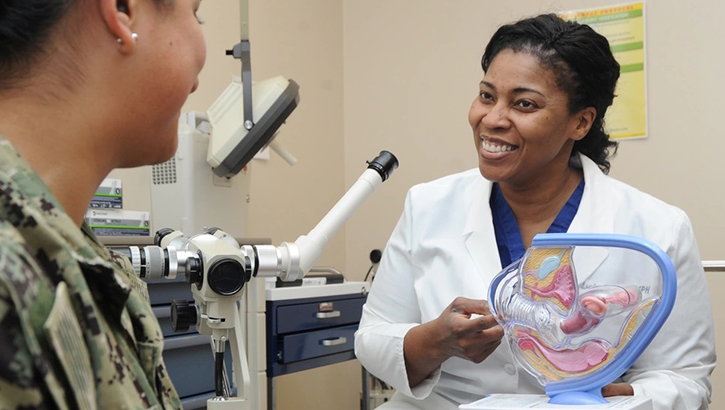
If the test finds HPV types 16 or 18 — high-risk, cancer-causing strains — your provider may recommend a follow-up exam called a colposcopy, said Pombier. Colposcopy is a diagnostic procedure in which a lighted magnifying instrument called a colposcope helps your provider examine your cervix, vagina, and external genitals. If your provider finds other high-risk HPV types, you likely will need a follow-up Pap test, Pombier explained.
HPV self-collection is not a substitute for routine well-women care, Pombier emphasized. “You need to maintain regular touchpoints with your clinicians to ensure you are up to date with all your health needs. While we encourage you to continue with your current screening option if you are satisfied with it, we recognize that traditional methods are not a good fit for everyone,” said Taylor.
“For those who have delayed or avoided screening, self-collection provides a new, more accessible alternative. By offering a choice that is both comfortable and convenient, our hope is to bridge the gap for those not currently being screened. When everyone participates in screening, we can ensure total force readiness and move closer to eliminating cervical cancer,” Pombier said.